

Advanced Training in Logotherapy & Existential Analysis
Module 1 - Logophilosophy
Unit 1 - Philosophical Foundations of Logotherapy
Unit 2 - The History of Logotherapy
Unit 3 - Introduction to Existential Philosophy
Unit 4 - Specific Philosophical Influences on Logotherapy I: Ancient Greek and Roman Philosophy
Unit 5 - Specific Philosophical Influences on Logotherapy II: Phenomenology and Existentialism
This module is designed to introduce students to Frankl’s fundamental assumptions about the person and to situate logotherapy within the broader context of existential psychotherapies. It also provides an overview of Frankl’s biography and the intellectual influences that shaped his work. As you go through the module, take your time to contemplate these foundational ideas, both through reflection assignments and in your daily life. Remember, logotherapy is best learned from personal experience.
Unit 6 - Anxiety as an Existential Condition
Unit 7 - What is Meaning in Logotherapy and Beyond?
Unit 8 - The Will to Meaning and the Defiant Power of the Human Spirit
Unit 9 - Human Agency: Choice, Responsibility, Control, and Facticity/Thrownness
Unit 10 - The Concept of Self-Transcendence
Unit 1 - Philosophical Foundations of Logotherapy
Unit 1 explores the main tenets of logophilosophy. Students will learn about the three foundational assumptions that underpin logotherapy: freedom of will, will meaning and meaning of life.
-
PDF of the presentation can be found here.
This unit is accompanied by an essay that you can find by clicking here.
Logotherapy reading:
Frankl, Viktor. “The Philosophical Foundations of Logotherapy.” Psychotherapy and Existentialism, by Viktor Frankl, Simon and Schuster, 1968.
-
To access the test for this unit, please click here.
Remember that you need at least 80% to pass the test. Passing the test is mandatory for the successful completion of the module. In case you do not pass, you are welcome to re-take the test as many times as you like.
-
Write an essay (at least 1,000 words) illustrating Frankl’s Cross. Reflect on your life and identify one example for each quadrant. You may briefly describe each situation for context, but focus primarily on your nonverbal reactions, state of mind, and emotions.
An instance of both meaning and success
Success without meaning
Lack of success but with meaning
Lack of both meaning and success
Unit 2- The History of Logotherapy
Unit 2 explores Viktor Frankl’s life and the historical development of logotherapy. A special emphasis is placed on Frankl’s experiences in concentration camps and their profound impact on his thought. Major post-Franklian figures in logotherapy are also mentioned.
-
PDF of the presentation can be found here.
This unit is accompanied by an essay that you can find by clicking here.
Logotherapy reading:
Frankl, Viktor E. Man’s Search for Meaning. 2004. Random UK. (Part I)
-
To access the test for this unit, please click here.
Remember that you need at least 80% to pass the test. Passing the test is mandatory for the successful completion of the module. In case you do not pass, you are welcome to re-take the test as many times as you like.
-
Choose one of the figures mentioned in the lecture, excluding Frankl. Research this person’s work using reliable online sources and prepare a structured overview of their main ideas. Your outline should be no shorter than 1000 words and should clearly present the key concepts, assumptions, and contributions of the selected figure.
Unit 3- Introduction to Existential Philosophy
In this unit, students will learn about basic existentialist ideas and major figures associated with existentialism. The historical and cultural circumstances that brought existentialist thought to the forefront of European philosophy will be explored in general terms.
-
PDF of the presentation can be found here.
This unit is accompanied by an essay that you can find by clicking here.
Further reading:
Cox, G. (2019). How to be an existentialist: 10th anniversary edition. Bloomsbury Academic
-
To access the test for this unit, please click here.
Remember that you need at least 80% to pass the test. Passing the test is mandatory for the successful completion of the module. In case you do not pass, you are welcome to re-take the test as many times as you like.
-
Write a 1000 word essay on any of the following topics; freely do your own research but list your references in APA format at the end of the esasy.
Topics:
Yalom’s Existential Givens
Anxiety: Kierkegaard and Heidegger
Authenticity in Kierkegaard and Sartre
What did Nietzsche mean by “God is dead”?
Rollo May’s view of anxiety
Unit 4 - Specific Philosophical Influences on Logotherapy, Part I
This lecture provides an overview of several Greco-Roman philosophical traditions that influenced Frankl’s thought. Its goal is to illustrate the diversity of intellectual influences that shaped Frankl’s thinking and to situate logotherapy within a broader philosophical context.
-
-
To access the test for this unit, please click here.
Remember that you need at least 80% to pass the test. Passing the test is mandatory for the successful completion of the module. In case you do not pass, you are welcome to re-take the test as many times as you like.
-
Choose Explore the four central virtues of Stoicism—wisdom, courage, justice, and temperance—as described by thinkers such as Epictetus and Marcus Aurelius. Write a reflection (approximately 1000 words) in which you consider how each of these virtues relates to the choices you make and the way you live your life.
In your reflection, discuss whether you recognize these virtues as values you personally endorse or aspire to embody. Consider whether you see them as guiding principles in your own life, and explain why or why not, using concrete examples from your experiences or decisions.
Unit 5 - Specific Philosophical Influences on Logotherapy, Part II
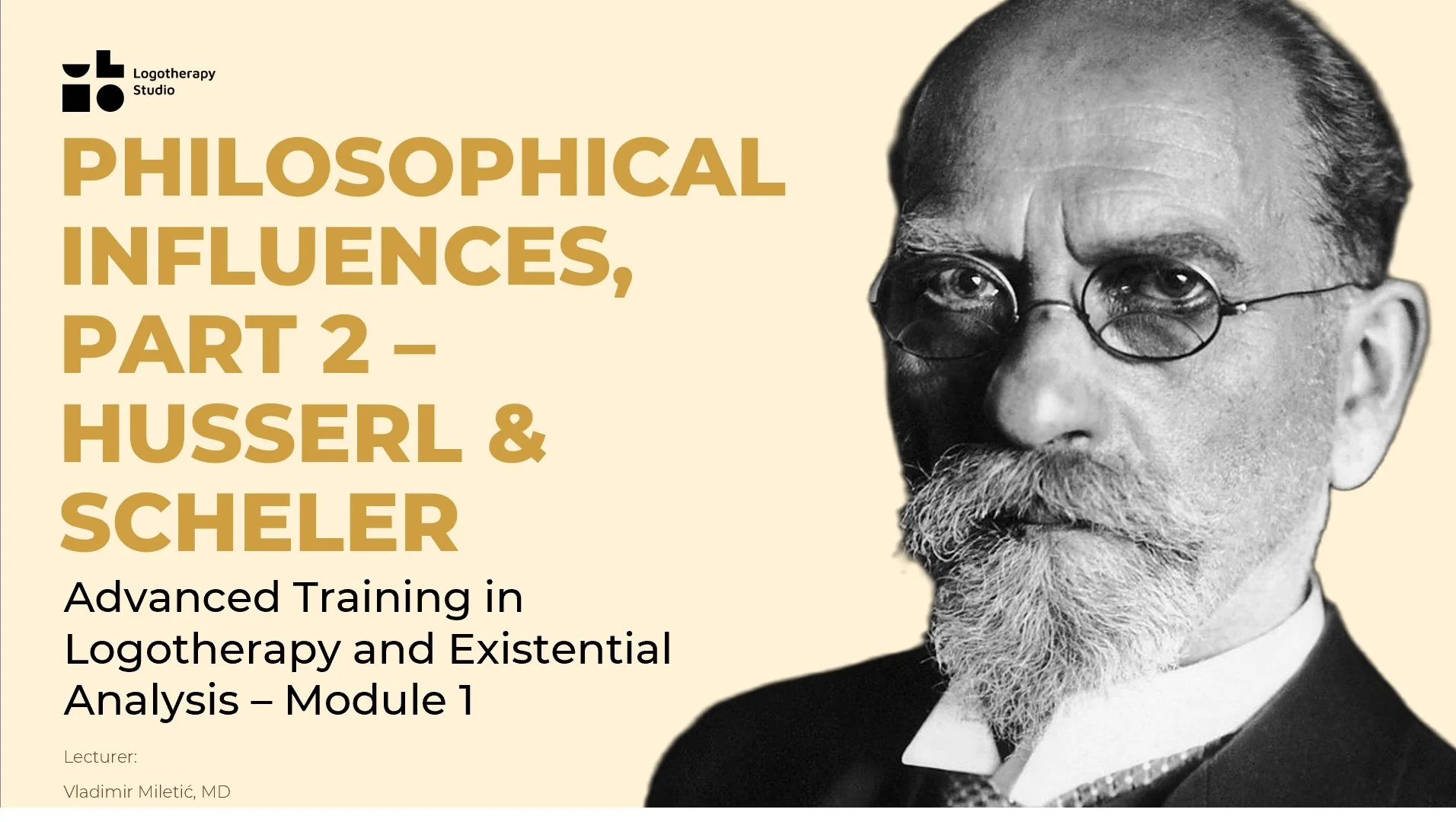
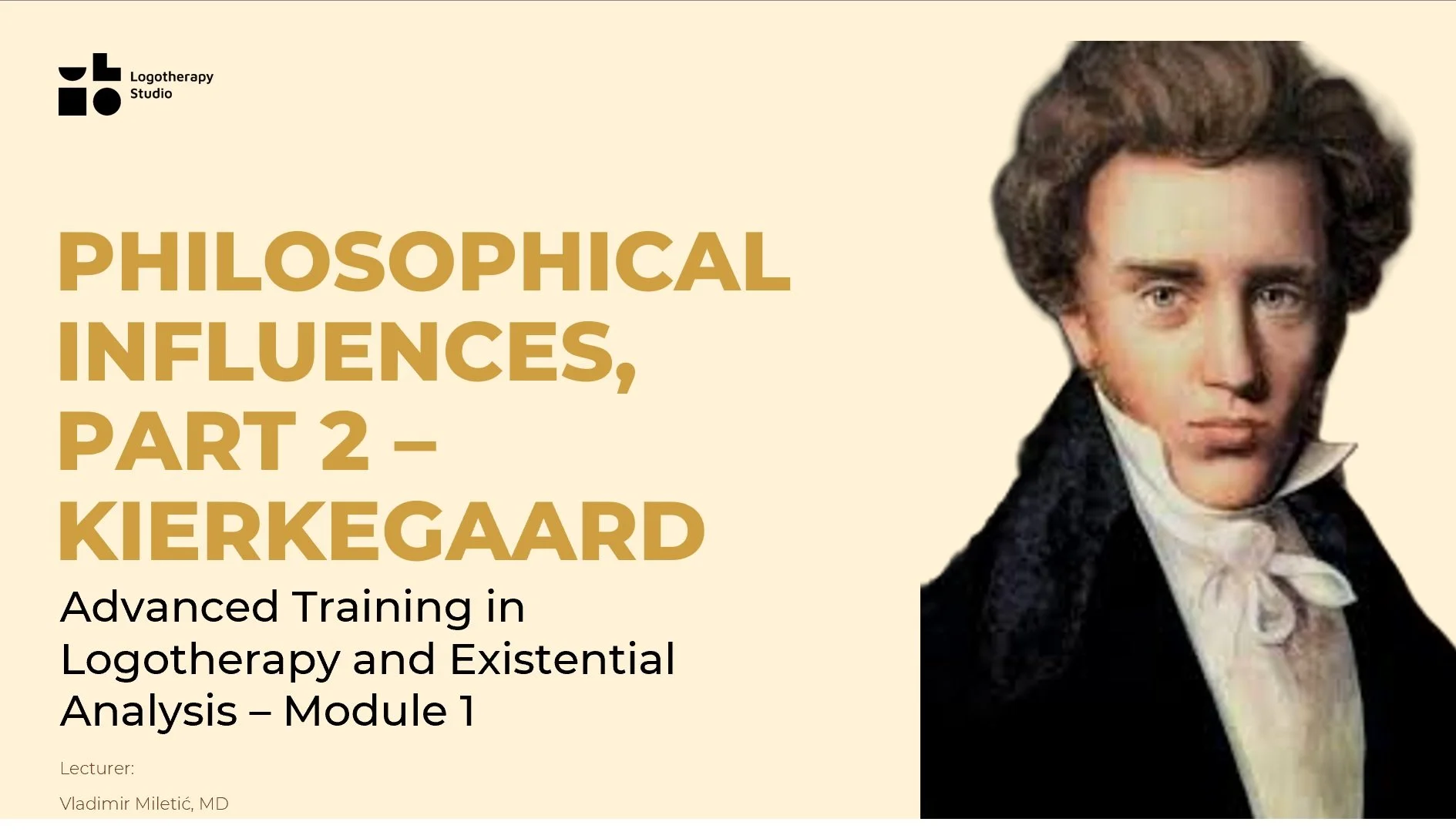
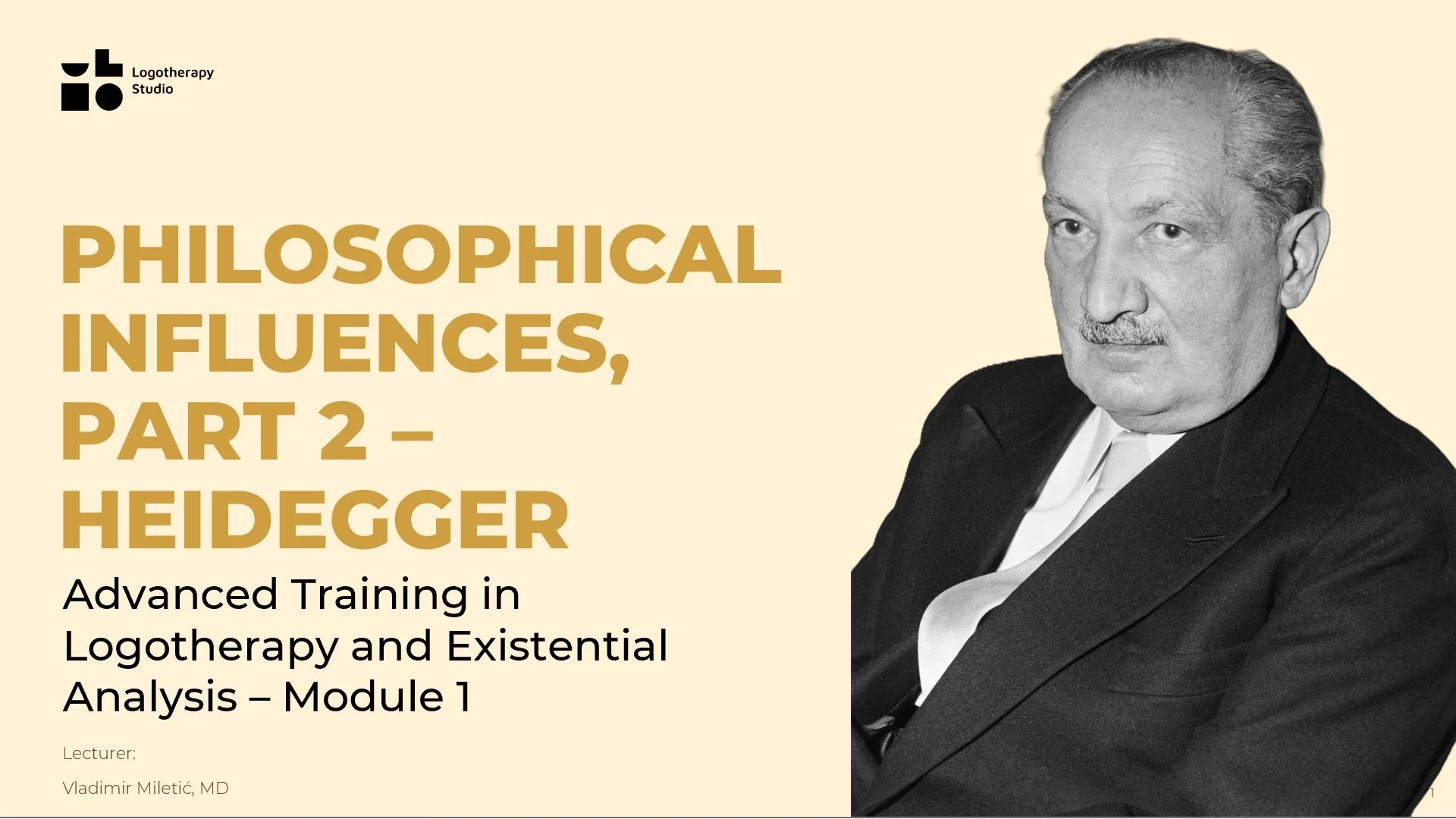
Unit 5 will be composed of three lectures that will address Frankl’s philosophical influences from a more recent time. Two philosophical movements and their representatives will be explored - phenomenology and existentialism. The first lecture will explore Husserl and Scheler and their phenomenology, as a method and an attitude. Particular attention will be paid to Scheler’s work on values and love. The second lecture will discuss Kierkegaard and the third will address Heidegger.
-
Existentialism: A Reconstruction, David Cooper
Heidegger, an Introduction by Richard Polt
-
This unit will involve three different tests.
For the test on lecture 1 click here.
For the test on lecture 2, click here.
For the test on lecture 3, click here.
Remember that you need at least 80% to pass the test. Passing the test is mandatory for the successful completion of the module. In case you do not pass, you are welcome to re-take the test as many times as you like.
-
Take Kierkegaard’s stages of development and explain them briefly: the aesthetic (pleasure and immediacy), ethical (responsibility and commitment), and religious (faith and deeper meaning).
Then reflect on your own life using this framework—identify which stages you’ve experienced, any transitions between them, and where you see yourself now.
Length: at least 5000 words.
Are you interested in learning more about existentialism in philosophy?
The lectures in this course are meant to touch the surface of existentialism, to introduce you to those very basic ideas that Frankl builds logotherapy on. But there is so much more to the philosophy of existentialism.
This course examines the major figures and works of the existentialist movement from a historical perspective. Søren Kierkegaard, Fyodor Dostoevsky, Friedrich Nietzsche, Martin Heidegger, Jean-Paul Sartre, Simone de Beauvoir, W.E.B. Du Bois, and Albert Camus are among the authors you will examine. You will be able to identify, analyze, and differentiate among important themes and figures in existentialism history. Most importantly, you will comprehend the contributions existentialist thinkers have made to our present view of human existence and our role in the universe.

Unit 6 - Anxiety as an Existential Condition
This lecture will addrress anxiety as an existential condition. It will demonstrate that anxiety is more than a clinical symptom to be treated, using an ecclectic combination of existentialist, constructivist and other thinkers.
-
-
Description text goes hereThis unit will involve three different tests.
For the test on this unit’s lecture click here.
Remember that you need at least 80% to pass the test. Passing the test is mandatory for the successful completion of the module. In case you do not pass, you are welcome to re-take the test as many times as you like.
-
Read Long’s Existential Anxiety and The Courage to Be and write a 5000 word essay on the ontology of courage and its relation to anxiety.
Unit 7 - Meaning in Logotherapy and Beyond

In Unit 7, we will explore meaning, and different existentialist position on meaning - whether it exists out there in the world (and what this means), or is it something that be assign to the world as we go through it.
-
Presentation pdf can be found here.
Required reading for the unit:
Frankl, V. E. (2014). What is meant by meaning? In The will to meaning: Foundations and applications of logotherapy (Expanded ed.). Plume.
-
Unit test is available here.
Remember that you need at least 80% to pass the test. Passing the test is mandatory for the successful completion of the module. In case you do not pass, you are welcome to re-take the test as many times as you like.
-
Summarize the required reading for this unit in 1 - 2 A4 pages of text.
Unit 8 - Meaning in Logotherapy and Beyond

In Unit 8, we will discuss the will to meaning as an existential driving force that moves the human being and originates in the noetic realm. The lecture will also examine the defiant power of the human spirit as a source of existential resistance.
-
Presentation pdf can be found here.
No other reading material is required for this unit.
-
Unit test is available here.
Remember that you need at least 80% to pass the test. Passing the test is mandatory for the successful completion of the module. In case you do not pass, you are welcome to re-take the test as many times as you like.
-
This unit involves two essays, each between 500 and 1000 words.
(1) Find and analyze an example of “existential resistance” from a movie, literature or news.
(2) How is the will to meaning manifested in your life?
Unit 9 - Human Agency: Choice, Responsibility, and Facticity/Thrownness

Unit 9 discusses human agency, the fact that every waking moment of our life we choose something - what to do, what to say and how to relate to events in our life.
-
-
Unit test is available here.
Remember that you need at least 80% to pass the test. Passing the test is mandatory for the successful completion of the module. In case you do not pass, you are welcome to re-take the test as many times as you like.
-
Write an essay, 1000 words. In this essay, I ask you to be your own therapist. Write the essay in the form of a dialogue.
Think of a situation from your past (or present) where you felt like you had no other choice but to do what you eventually did. Frankl’s theory tells us that we always have a choice. Seeing a situation as choiceless is a form of bad faith (Sartre). Investigate the situation and try to uncover the reason it was important for you to present the situation as being without a choice.
Unit 10 - The Concept of Self-Transcendence
Unit 10 talks about self-transcendence and certain principles of existentialist thinking relevant for the concept: relational being, the problem of the other, religion and self-distancing.
-
-
Unit test is available here.
Remember that you need at least 80% to pass the test. Passing the test is mandatory for the successful completion of the module. In case you do not pass, you are welcome to re-take the test as many times as you like.
-
Think about self-transcendence in your own life. Write an essay (minimum of 500 words) about your own experience with self-transcendence, the good, the bad and the ugly.